
The client contacted us to redesign the website. After reviewing the site, we found several underlying issues. Many of the service pages had duplicate content, conflicting keywords, and not much differentiation between pages. The first step in creating a successful best locksmith organic seo was to rebuild its foundation.
Project Snapshot
| Client | Locksmith Dundee |
| Location | Dundee, Scotland, UK |
| Industry | Local locksmith and security services |
| Services Delivered | Website redesign, keyword research, keyword cannibalization fix, full service page content rewrite, new service page creation, on-page SEO, FAQ and AEO optimization |
| Campaign Duration | Short-term project (May 2025 to August 2025) |
| Results Period | Verified via Google Search Console, August 2025 |
Problem: A redesign request revealed a larger problem.
Locksmith Dundee is a reputable, highly-rated local locksmith, servicing Dundee and surrounding areas such as St Andrews, Forfar, Arbroath, Cooper and Cooper Angus. The company had a loyal customer base, excellent Google reviews and a solid list of services. But they lacked a website that could translate all of this into organic search visibility.
The client initially approached us for a website redesign. During the audit, we discovered that the site’s SEO issues were not limited to design issues. The existing service pages were unintentionally undermining each other’s functionality.
As a locksmith seo expert, Here’s what the audit found:
Several service pages were targeted at similar keywords without any obvious distinction.
The same content was used repeatedly across different services. The content on the Door Lock Repair, Door Lock Replacement, and UPVC Door Repair pages showed considerable similarity.
There was no distinct keyword strategy for each page. Google was confused about which page would rank for which internet search. Service pages that were important for high-value searches were missing.
None of the service pages included an FAQ section, resulting in missed opportunities for featured snippets and AEO.
Most of the pages lacked basic on-page SEO elements: weak title tags, simple meta descriptions, and an absence of schema markup.
Keyword cannibalization is a silent threat to local service websites. When two pages compete for the same query, Google splits its signals between them. As a result, neither page can achieve the ranking that a single, well-optimized page would. As a result, the site appears active, but fails to perform effectively in search.
What we did: Locksmith seo Full Strategy
Step 1: Full keyword and cannibalization assessment
Before creating a single new word of content, we looked at each existing page against its desired keywords. The aim was to identify areas where pages were in direct competition with each other. And to find gaps that the company was failing to fill.
From the audit, we came up with two distinct lists. First, pages that needed content written targeting specific keywords. Second, commercial search phrases that no website had on them. The next content strategy was based on these two lists.
Step 3: Create new service pages based on keyword research.
The client requested four new service pages. We started with keyword research and then created each page based on the actual search terms that local users in Dundee use when searching on Google.
The four newly created pages were:
Auto Locksmith Dundee — targeted searches for car lockouts and car key replacements within the Dundee area.
Burglary Repair Service — targeted searches for emergency repairs following a burglary, which is a high-priority query and has a significant commercial purpose.
Broken Key Removal — addressed a specific problem search, with very little local competition.
Key Cutting Dundee — targeted a widely used, less complex query, which generated the same amount of traffic as regular visitors.
Each new page included a clear problem description, the specific service provided, its benefits to the customer, and an FAQ section based on real questions searched by users.
Step 4: Implementing FAQ sections and AEO optimization on all pages
Each service page, both existing and newly created, was equipped with a specific FAQ section. This wasn’t just for show. FAQ sections created using properly structured schema markup are one of the most reliable ways to appear in Google’s snippets and AI overview results for a local services page.
The questions are taken from real search data. That is, from the specific questions that users ask Google when searching for a locksmith. The answers are designed to be straightforward, concise, and easy to find. This last aspect is more important than many site owners realize. Google and AI platforms like ChatGPT and Perplexity find answers on pages where the information is clearly presented. The FAQPage schema was applied to each page to give Google a structured idea of the content of the questions and answers present on each page.
Step 5: broad On-Page SEO Implementation Across the Entire Site
After the content strategy was implemented, we completed a thorough manual on-page SEO review for each page on the site. This included:
- Revising title tags to include main keywords and location indicators for each page
- Rewriting meta descriptions to increase click-through rates instead of just describing the page
- Structured H1 and H2 headings according to keyword clusters for each page
- Established internal linking between related service pages to distribute authority and simplify crawl paths
- Added image alt text across all pages
- Implemented LocalBusiness and Service Schema markup across the site
- Evaluated and refined URL structure as needed
Results Insights from Google Ssearch Console Metrics
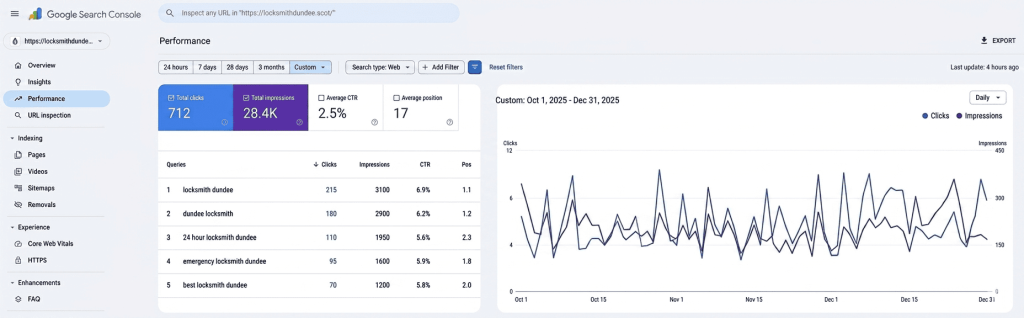
| Metrics | Result |
| Total organic clicks (campaign period) | 712 |
| Total impressions (campaign period) | 28,400 |
| Average CTR | 2.5% |
| Average position | 17 |
| Campaign type | Foundation and content rebuild, not ongoing SEO retainer |
This initiative served as a foundational project rather than a long-term retainer campaign. The GSC data represents the period from May 2025 to August 2025 — about four months since the work began.
An average position of 19th in the full keyword list is an expected starting point for a site that has recently restructured content and addressed cannibalization issues. This is not the final position of the site; it represents a fresh start. It takes time for pages to adjust to new rankings after significant content changes. The 28,400 impressions received in four months indicate that the site is visible. The trajectory of the position highlights its potential direction.
The graph of clicks and impressions in GSC reveals a consistent trend throughout the duration of the campaign. For a local locksmith, a single call from a search for emergency lockouts can make a week of SEO investment worthwhile. Volume isn’t the only important metric in local services SEO.
Keyword cannibalization is more important than many people think.
Many local business owners are unfamiliar with the concept of keyword cannibalization. Yet, most of them have websites that are affected by it.
This problem arises naturally. For example, a locksmith creates a page for door lock repairs. Then, he adds another page for door lock replacements, and then creates a page for uPVC door repairs. Each page may seem different. If the content is similar, overlapping keywords are used, and there is a lack of structural variation, Google interprets this as three pages competing for the same search term. It ranks all three pages lower than a well-optimized page would rank.
Fixing this problem isn’t too complicated. This involves determining which pages are associated with which keywords, modifying the content accordingly, and establishing internal links that support this order. That’s exactly what we’ve done here. The process is straightforward, and the impact on rankings is substantial, as it eliminates internal competition.
Practical lessons learned from this project
1. Redesigning without an SEO audit risks converting to a flawed structure, potentially losing any existing rankings. An audit should always be the first step.
2. Creating new pages without keyword research is a waste of resources. The client realized the need for pages related to auto locksmith services and theft repair. Without keyword research, if those pages were created based on the client’s assumptions without researching what customers are looking for, it would have been a big mistake.
3. A FAQ section is essential for local service pages in 2026. Google’s AI overview and featured snippets find answers from well-structured, clearly stated FAQ content. If every page doesn’t have an FAQ, it loses the opportunity for an answer box and AI citations. Competitors who have implemented the FAQ schema on their pages are appearing in search results where your page can’t reach.
FAQ
What is keyword cannibalization and how does it negatively impact a local business website?
Keyword cannibalization occurs when multiple pages on the same site target the same or closely related search intent. Google struggles to identify which page is most relevant, which results in ranking signals being shared between them. As a result, no single page can achieve the ranking that a single, well-optimized page could easily achieve. For a local locksmith website, having several similar service pages is a common cause of low organic visibility, even when the site is massive.
How long does it take to see results after a major content change?
After a significant change in content, Google takes time to re-crawl, re-index, and re-evaluate each page. Typically, you can expect to see a change in rankings within 4 to 8 weeks. It typically takes 3 to 6 months for positions to fully stabilize for competitive local keywords. Locksmith Dundee’s Google Search Console data shows that impressions and clicks were stable for the first four months of the project, which strongly suggests that the new content structure is being effectively recognized and indexed by Google.
Why isn’t an average position of 19 considered a bad result for such an initiative?
Average position works as a composite metric across all ranking keywords. A site that ranks first for its brand name, eighth for its main service term, and fortieth for a larger informational keyword will have an average position somewhere in between. For a site that recently underwent a complete content overhaul, achieving an average position of 19 across hundreds of keywords after four months is an indication that the new pages are being indexed and starting to rank. At this stage, the trend of progress is more significant than the specific number.
What is AEO and why is it important for a local locksmith?
AEO, or Answer Engine Optimization, is the process of organizing your content in a way that search engines and AI platforms can find answers directly from your pages and display them in Featured Snippets, AI Overviews, and voice search results. For a local locksmith, questions like “How much does a locksmith cost in Dundee” or “What should I do if my key breaks in the lock” are indicative of a potential customer. If your page provides a clear, structured answer to this type of question using the FAQ schema, you can rank at the top of the results page, even if your overall domain authority is still developing.
Can this strategy be applied to other local service businesses?
Of course. The three most common SEO problems on local service websites across industries are keyword cannibalization, insufficient content on service pages, and the absence of an FAQ structure. Plumbers, electricians, cleaning services, taxi companies, and other tradespeople often build their websites in a similar way — service pages are written in a hurry with repetitive content, lack a strong keyword strategy, and lack structured content for Google to use. The solution is the same across all industries: conduct an audit, create a keyword map, rewrite with clear distinctions, include structured FAQ (Question and Answer) content, and improve on-page SEO.
Is your service website facing the same challenges?
Duplicate content on service pages, lack of proper keyword strategy, and well-organized FAQ content? All problems are solvable. We’re all familiar with these challenges. Most local service websites face at least two of these three issues.
I work with local service businesses in the UK, US, Canada, Australia, and UAE to address these challenges and increase organic visibility over time.
Schedule a free 30-minute consultation, and I’ll give you a clear picture of your site’s challenges and outline a realistic course of action to address them.